Environmental Vocabulary for Kids
Recycling and Environmental Vocabulary for Kids: Words and Activities teaches English terms for waste, nature, and daily choices. Children can start with visible objects—a bottle, bin, box, or bag—then learn actions such as reuse, repair, and recycle. Older learners can discuss pollution, renewable energy, and conservation. Sorting objects, following instructions, explaining choices, and repeating vocabulary through stories and family routines strengthen recall.
📥 Environmental Vocabulary Practice
Recycling, nature, and everyday eco-friendly choices
Leave your email — we'll send the PDF to your inbox.No spam — the PDF plus one short reminder. Unsubscribe anytime.
Core Words and Phrases
When planning Recycling and Environmental Vocabulary for Kids: Words and Activities, start with concrete nouns and action verbs. A child can point to a can or pick up paper, while sustainability needs explanation. Teach related words in small groups, then practise complete sentences.
The table groups terms by purpose. Younger children can use the first two columns. Learners aged nine and above can gradually add vocabulary about natural systems and environmental problems.
Practise phrases such as “sort the waste,” “save water,” “turn off the light,” “pick up litter,” and “use the bottle again.” These chunks support speech before children build longer explanations.
Putting the Words into Context
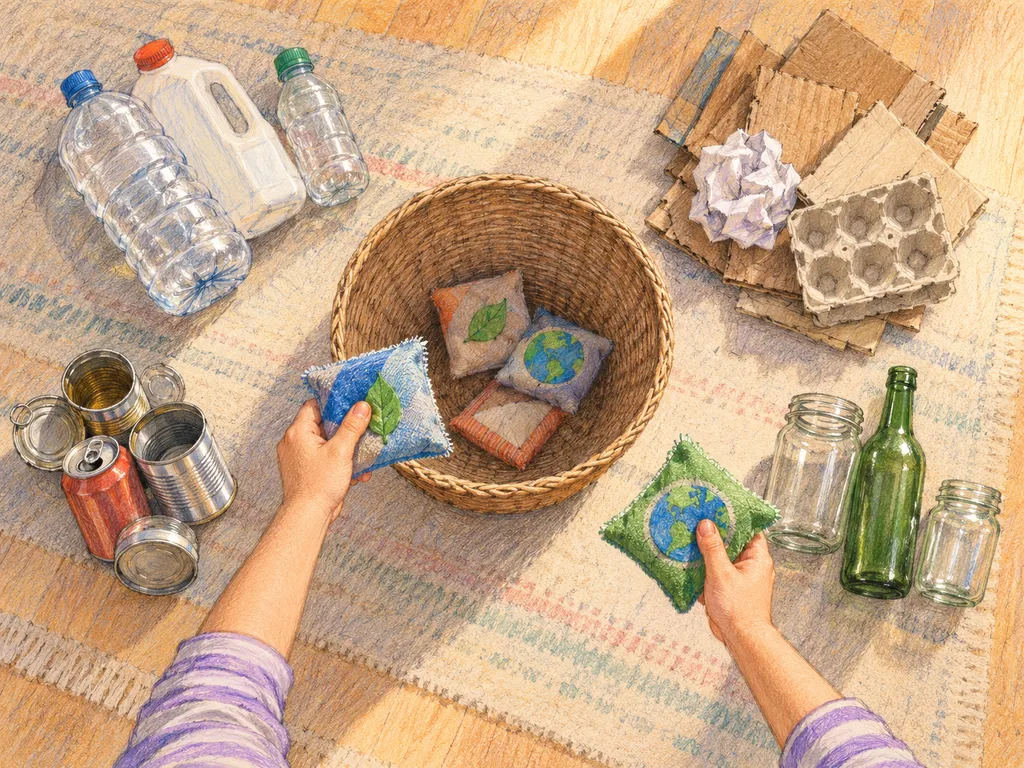
A child remembers a word by connecting it to an object, action, and reason. Show a cardboard box: “This is cardboard. We can reuse it for a craft or recycle it.” Ask the child to choose and explain: “I will reuse the box because I need a container.”
Teach verbs through contrast. To reuse means to use an item again, such as refilling a bottle. To recycle means to process material for future use. To reduce means to consume less. To repair means to fix something instead of replacing it.
Families using Recycling and Environmental Vocabulary for Kids: Words and Activities can practise through a five-minute routine. After a meal, name three objects and choose what happens next: “We wash this jar,” “We recycle this can,” or “We put food waste in the correct bin.” Follow local recycling rules because accepted materials vary.
How to Introduce New Environmental Words
Start with four to six words for children aged four to seven. Say each word, show the item or a picture, then ask the child to point, match, or move it. Give short instructions: “Find the paper,” “Put the can beside the bottle,” and “Show me the recycling bin.” Speaking follows comprehension.
Children aged eight to eleven can learn word networks. Place plastic in the centre of a page, then add bottle, bag, reuse, recycle, and plastic waste. Ask for a sentence linking two branches. The response reveals whether the child understands each relationship.
Older learners can compare choices and explain reasons: “A reusable cup may create less waste than a disposable cup.” Multilingual children may name an idea in another language first. Accept the connection, supply the English term, and practise it in a new sentence. Aim for flexible use instead of word-for-word translation.
Activities for Different Ages
For ages four to six, try clean-object sorting. Place paper, cardboard, a glass jar, and a metal can on a table. Name one material and ask the child to touch it. Then instruct: “Put the cardboard in the paper group.” Check objects for sharp edges or residue first.
For ages seven to nine, make “keep, reuse, recycle, or throw away” cards. The child chooses a household object, places it under one card, and completes a sentence: “We can reuse this bag.” Ask for a reason or an alternative choice.
For ages ten to fifteen, create a decision task. Compare two lunch containers, transport options, or energy sources. The learner uses at least five target terms to describe benefits, limits, and local conditions. This turns Recycling and Environmental Vocabulary for Kids: Words and Activities into language for reasoning instead of slogan recall.
Short Practice Ideas That Build Recall
Recycling and Environmental Vocabulary for Kids: Words and Activities needs no long lesson. Try a one-minute word hunt, label clean objects, complete sentence starters, or request one environmental instruction. Repeat familiar vocabulary across days while changing the task, not the word set.
Sort, Say, and Explain
Choose six safe household objects. Your child sorts them by material, names each item, and selects an action: reuse, recycle, repair, or throw away. Finish with two sentences: “This is a glass jar. We can reuse it for storage.”
Games should test understanding and speech. In “Odd one out,” offer three words—paper, cardboard, forest—and ask which belongs to another group. In a guessing game, describe a word without naming it: “It is unwanted material on a street or in a park.” The answer is litter.
LearnLink tutors adapt the material to each learner’s age and English level. A beginner may identify and sort objects; a confident child can compare options or explain cause and effect. Each learner explores the same core ideas at a suitable language load.
Common Mistakes and How to Correct Them
Children may treat rubbish, waste, and litter as identical. Rubbish or trash is unwanted material. Waste is broader and includes wasted water or energy. Litter is rubbish left in a public place. Correct meaning through examples instead of long definitions.
Children also confuse “recycle a bottle” with “reuse a bottle.” Demonstrate both actions: put one bottle in a recycling container and wash another for future use. Replace “make pollution” with natural phrases: “cause pollution,” “reduce pollution,” or “pollute the air or water.”
Do not correct every grammar error during vocabulary practice. First confirm that the child chose the right environmental word. Then model one improved sentence: “Yes, we can recycle the can.” The learner hears a correct pattern without losing focus.
- Try sorting five household items with children aged six to nine.
- Practice pronouncing ten recycling words using picture cards for five minutes.
- Use one age-appropriate book to correct confusing words like reuse and recycle.
- Ask your child to explain three mistakes and model correct sentences.
- Repeat the activity tomorrow and praise every accurate environmental vocabulary choice.
When a word has several meanings or pronunciations, Cambridge Dictionary is a useful check before turning it into child-friendly examples.
Frequently Asked Questions
How Many Environmental Words Should a Child Learn at Once?
Four to six new words suit young beginners. A child who reads and speaks English confidently may manage eight to twelve related terms. Include earlier vocabulary so recall develops over time. Move on when your child understands the words in instructions and uses some in short sentences, not merely repeats a list.
Should Parents Translate Recycling Vocabulary?
Translation can help with an unfamiliar idea, especially in a multilingual family. Use it briefly, then connect the English word to an object, picture, action, or sentence. Show a jar while saying glass, then ask, “Can we reuse this glass jar?” The child gains multiple routes to meaning without depending on translation.
What Is the Easiest Way to Explain Recycle, Reuse, and Reduce?
Use one object and three choices. Reuse a container by filling it again. Recycle it through the correct local collection system. Reduce waste by choosing fewer disposable containers. Let your child perform each choice and say a matching sentence. Concrete actions distinguish the terms better than dictionary definitions.
Can This Vocabulary Be Practised Without Recycling Materials at Home?
Yes. Recycling and Environmental Vocabulary for Kids: Words and Activities works with drawings, photos, toys, or objects seen during a walk. Your child can sort picture cards, describe litter without touching it, or explain how to save water and energy. Follow local recycling rules because collection systems and accepted materials differ.
A short one-to-one lesson can show what level and pace fit your child — book a trial English lesson.
Stay updated on our latest tips and resources by following us on Instagram LearnLink.